For Laurie Bussmann and the Orijin team · October 2026

Mental health programming your sales team can prove.

Written by clinicians. Built for corrections. Measured from day one.

On October 6 you asked how Mind Rehab would work inside Orijin: usage data, single sign-on, HIPAA and forms. Here are straight answers, what's live today, and what we'd set up together.

See the answers
Usage data · Single sign-on · HIPAA · Secure forms
Mind Rehab / recovery education
MOUD & Harm ReductionOriginal lesson film
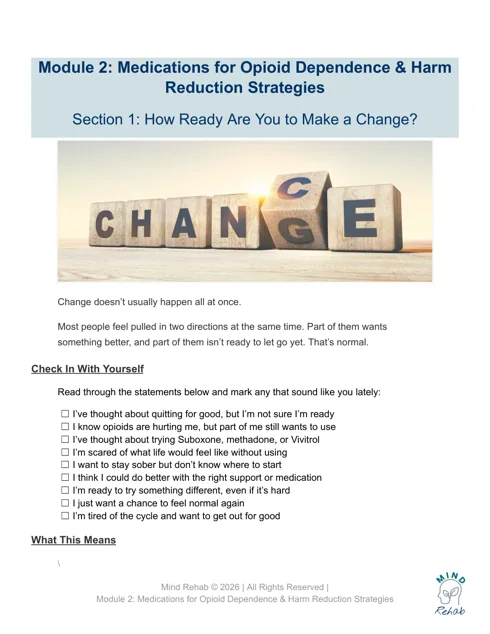
Workbook page on readiness for change, with a CHANGE illustration and private reflection prompts.
Participant workbook · original page
20,847course completions on tablets since Dec 2025
Your questions, answered

The short version.

Each answer links to the detail. Labels on this page show what's live today and what we'd set up with your team.

Can Orijin see usage data?Yes.

Starts, completions, certificates and time in course, by facility, course and week. Anonymous by default. We'd deliver it by API or export, with completions straight into your Canvas gradebook.

See the data plan →
Can learners sign in from the tablet (SSO)?Yes.

Automatic tablet sign-in already runs on our live platform, with no passwords for learners. For Orijin, we'd use a signed launch your team approves.

How sign-in works →
What about HIPAA?Safeguards in place.

Health information stays in our environment on AWS, under a signed Business Associate Addendum, with an encrypted database and account-wide logging.

See the safeguards →
Can facilities collect forms on the tablet?Ready to set up.

Intake, health requests, insurance or VA paperwork, filled out on the tablet and kept under our BAA. Name your first form and we'll build it into the test site.

See the clinical tools →
How we fit

Built to plug in, not compete.

Orijin stays the learner's home base. Mind Rehab adds the clinical layer your platform doesn't need to carry.

Orijin

The home base

  • Your tablets and learning platform
  • Education and job pathways, including Honest Jobs
  • The learner relationship and your brand
Mind Rehab

The clinical layer

  • Clinician-written mental health and substance use courses
  • The home for health information: forms, screeners and care-team tools, under our AWS BAA
  • Weekly usage data for your sales team

At Orijin sites, Orijin owns the relationship. We support your team. We don't sell around it.

Proof on tablets today

Learners finish what they start.

Our courses went live on Edovo's tablet platform in December 2025. These are our own numbers from the Edovo partner dashboard.

75%

of course starts end in a completion

27,651course starts
20,847completions
1,400+facilities with learners
9,303learning hours
What these numbers mean

Unique course starts and completions for Mind Rehab content on Edovo, December 2025 to October 12, 2026. Nearly all of the volume (27,200 of 27,651 starts) comes from our free sleep course, which is open to every learner. Our 18 clinical courses on Edovo are a paid add-on, so their base is smaller: 451 starts and 364 completions (81%).

These are engagement numbers, not clinical outcomes, and they don't prove cause and effect. It's the same plain, checkable reporting we'd give Orijin.

Usage report previewReal Edovo data
Our 18 clinical courses on Edovo
451starts
364completions
81%completion rate
13 of 18clinical courses finished at 80% or higher
Our clinical courses on Edovo with 80% or higher completion
CourseStartsCompletion
Managing Depression While Doing Time17
94%
Fear About Transferring to Prison16
94%
Stimulants and Your Brain27
93%
Managing Anxiety While Doing Time21
90%
Understanding Mood Disorders19
89%
Alcohol and Your Brain36
89%
Mental Health & Homelessness17
88%
Rebuilding Yourself24
88%
Reentry & Life Skills14
86%
Psychosis & Schizophrenia23
83%
Breaking the Cycle of Reoffense17
82%
Suicide Prevention16
81%
Incompetency to Stand Trial20
80%

Courses at 80% or higher among our 18 clinical courses on Edovo, Dec 2025 to Oct 12, 2026. The other five ran 64% to 78%. Orijin's version would show your sites, by facility and by week.

01 · Usage data & API

The numbers your sales team has been missing.

You choose the level of detail. The default keeps every learner anonymous.

Level 1 · Default

Totals

Starts, completions, certificates and time in course by facility, course and week. We hide very small counts so no one can be singled out.

For sales decks, renewals and contract reports
Level 2

Coded

Learner-level activity under a random code, never a name or booking number. Shows repeat use, pacing and paths through courses.

For program evaluation
Level 3 · Under a BAA

Identified

Linked to the facility's own records so care teams can follow up. Only under a signed Business Associate Agreement.

For clinical follow-up

Ready to set upSales-ready by design. Weekly numbers for your team, plus a one-page facility summary to bring to renewal meetings.

Two ways the data can reach you

Ready to set upRecommended start

Launch from your Canvas with LTI 1.3

Learners open Mind Rehab right from your platform. The same connection signs them in and sends course completions back to your gradebook. Screener and form answers never travel back. Courses stay on our platform, so every update reaches every site at once.

Ready to set up

Reporting API or weekly export

A read-only reporting API, with the access method agreed with your team, or a scheduled CSV file, at the level you choose. Built for sales dashboards and renewal reports.

For your tech team: data fields and a sample API response
FieldLevel
Facility and state1+
Course and lesson1+
Week or custom date range1+
Starts, completions and completion rate1+
Certificates earned1+
Assigned by staff or chosen by the learner1+
Time in course, where the course tracks it1+
Random learner code2+
Start and finish times, repeat visits2+
Facility learner ID3
Screener results and form responses3

Never shared without a BAA: names, booking numbers, screener answers, form responses or clinical notes.

GET /api/v1/usage?facility=FAC-104&week=2026-11-02

{
  "facility": "FAC-104",
  "state": "TN",
  "week_of": "2026-11-02",
  "course": "Opioids & Your Brain",
  "starts": 18,
  "completions": 15,
  "completion_rate": 0.83,
  "certificates": 15,
  "time_in_course_minutes": 412,
  "assigned_by_staff": 6,
  "self_selected": 12
}

Illustrative Level 1 example, not real data. We'd agree on field names and delivery with your team.

Full details: AWS environment one-pager · Moodle setup one-pager (each with a PDF download)

02 · Single sign-on & privacy

Simple sign-in.
Health data kept apart.

Checked against our AWS account and platform settings in October 2026.

How single sign-on would work with Orijin

01Tap

The learner opens Mind Rehab from their Orijin tablet.

02Signed launch

Your platform sends a signed launch (LTI 1.3 or OpenID Connect) with the learner's ID.

03Account ready

Our platform checks the signature, then opens their account or creates it the first time.

04Straight to learning

They land in their courses. No username, no password.

LiveOur tablet sign-in signs a learner in automatically from a learner ID at launch, and creates their account the first time. We verified it on our production platform in May 2026.

Ready to set upFor Orijin, we'd use the same LTI 1.3 connection that sends completions to your gradebook, set up before any health information is collected.

Safeguards in place today

  • AWS Business Associate AddendumActive since May 21, 2026
  • Encrypted databaseEncrypted at rest with its own dedicated key
  • Built to stay upDatabase copied across two AWS Availability Zones, with deletion protection
  • Account-wide logging and threat monitoringAWS CloudTrail and Amazon GuardDuty
  • Production kept separateIts own database and audit trail, apart from development
  • Closed by designLearner messaging and blogs turned off, with encrypted connections (HTTPS)

HIPAA is a shared responsibility, not a certificate. Before any health information moves, we map the data flow with your team and sign a BAA with Orijin or the facility. Send us your vendor security questionnaire and we'll answer it in writing.

03 · Clinical tools

The clinical side.
Many ways to use it.

Health information, clinical review and care-team workflows stay in our BAA-covered environment and open from your tablets. Completions and certificates flow back to Orijin.

LiveRunning todayReady to set upBuilt in, configured with youComing nextOn our build list
Live

Assign in bulk

Enroll one person or a whole group in a course in a few clicks.

Live

Staff resource library

Printable workbooks and matching facilitator guides for running groups.

Live

Custom courses

Need a topic we don't have? Our clinicians build it for you.

Coming next

Screeners and rechecks

Assign a screening tool, then schedule a recheck to see what changed.

Coming next

Requests that flag a need

When someone asks for a diagnosis-specific course, the care team hears about it. A request can be a quiet sign someone is struggling.

We'd rather show you a clear “Coming next” than oversell. Anything marked Live can be demoed on our site.

04 · Programming · Opioids & Your Brain

One topic.
Three ways to use it.

The same lesson works on the tablet, in a group and on paper. Here's one course in all three formats.

“We have had inmates that like a group setting and others that would prefer a more individual self-paced setting; both types have given great reviews of the topics…”
Assistant Correctional Administrator, Mountrail County, ND · on our printed workbook program

The clinical catalog

Highlights from our 26 courses, 23 of them also in Spanish. Our substance use courses can also fit programs funded with opioid settlement dollars.

Substance use
Opioids & Your BrainAlcohol and Your BrainStimulants and Your BrainAddiction & Recovery
Mental health
Managing Anxiety While Doing TimeManaging Depression While Doing TimePTSD & TraumaSuicide PreventionADHD, Focus & HabitsGetting Better SleepRestful NightsHandling Isolation During LockdownsFear About Transferring to PrisonMental Health & Homelessness
Staff-approved
Schizophrenia & PsychosisBipolar Disorder in CustodyIncompetency to Stand Trial
Court & reentry
Facing CourtRebuilding YourselfThe Cycle of ReoffensePreparing for Release
Medical
DiabetesHypertensionSexually Transmitted Diseases

Clinical guardrails. Lessons focus on coping skills, not self-diagnosis, and diagnosis-specific courses can be set to open only with staff approval.

05 · Who builds it

Built by people who've worked inside.

Every course is written by clinicians who know custody, then reviewed and signed off before it reaches a learner.

Ashley Miller, PMHNP-BC

Ashley Miller, PMHNP-BC

Founder & CEO

In correctional healthcare since 2017, now as a psychiatric nurse practitioner. Writes our courses and builds our clinical platform.

Yalda Safai, MD, MPH

Yalda Safai, MD, MPH

Psychiatrist & clinical reviewer

Correctional psychiatrist with a master's in public health and six years in California county jails. Reviews our courses for clinical accuracy.

Mike Bumpus, MBA

Mike Bumpus, MBA

SVP, Correctional Partnerships

Twenty years in corrections. Leads our work with partners and facilities.

30+years of correctional experience across our team

How every course is made

01

Research

We start from current clinical evidence and the realities of custody.

02

Written by our clinicians

Every lesson is written line by line by people who have treated patients in custody.

03

Clinical review

Practicing clinicians in psychiatry, nursing and social work go through it with a fine-tooth comb.

04

Refine and sign off

We revise until every reviewer signs off.

05

On record

Each review is documented and kept on file.

What we hear back

“I would say the journaling aspect is very well received… all inmates have used the handout and did a lot of the exercises and journaling.”
Administrator, Mountrail County, ND · on our printed workbook program

After the lesson on the amygdala, the brain's alarm system, one woman told us her trauma finally made sense to her, and so did the way she reacts.

A young man told us he had never thought of the violence he'd lived through as trauma. The PTSD lesson gave what he was carrying a name.

Participant stories are paraphrased from real conversations. Names and details are left out to protect their privacy.

Next step

Let's start with the data.

1

Send us your integration checklist

Or your vendor security questionnaire, or an intro to your Canvas admin. We'll map sign-in and the data fields to it.

2

We set up a test site

Single sign-on, a few courses, your first form and a live usage report, ready for your team to try.

3

Your sales team sees real numbers

Weekly reports from the first learners, in the format they need.

Original program page

Original program page.

MOUD & Harm Reduction: the first 60 seconds

The first 60 seconds of an original Mind Rehab lesson film, with its own audio and on-screen captions. Open the video file ↗